


Historians and information technology experts from the Academia Sinica yesterday released a Web-based Geographic Information System (WebGIS) Atlas containing hundreds of maps of Taiwan's historical culture and natural resources over a 400-year time frame.
At a press conference held yesterday to announce the result of a two-year research project funded by the National Science Council (NSC), scientists said the interactive database involving history, current knowledge and advanced information technology could be regarded as a virtual center for Taiwan studies.
According to Academia Sinica Vice President and project investigator Liu Tsui-jung (
The 400-year time frame includes different periods ranging from the Dutch occupation and Spanish rule, the Ming Dynasty, Qing Dynasty and the Japanese era to the present.
In addition, Liu said, researchers produced "thematic maps," which can be classified into diverse categories, ranging from population distribution, religion, education, national defense, transportation, economic, industrial and public health to Aboriginal culture.
"The database will be a useful platform in different fields to conduct interdisciplinary researches," Liu said.
Fan I-chun (
"To show environmental changes in the past to students, a teacher from an elementary school can easily superimpose a local map onto another to show natural resources in that area at different times," Fan said.
Similarly, Fan said, users can find out what jurisdiction their home fell under in the Qing Dynasty or if any churches were established nearby in the period of Japanese colonization. Defense zones in different periods, changes in river courses or the Taipei train map of 80 years ago can be easily retrieved.
To further promote Taiwan studies, an English introduction will be added, Fan said. Foreign researchers interested in using the database, however, are required to be familiar with Chinese.
Currently, free access to the database maintained by the Academia Sinica remains unavailable to the public, due to unsolved intellectual property problems.
NSC deputy minister Hsieh Ching-chih (
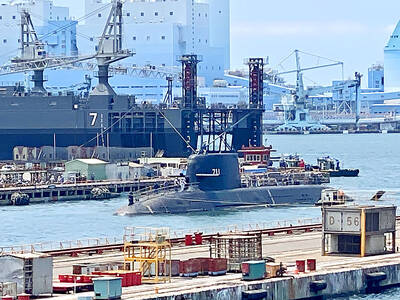
AGING: While Japan has 22 submarines, Taiwan only operates four, two of which were commissioned by the US in 1945 and 1946, and transferred to Taiwan in 1973 Taiwan would need at least 12 submarines to reach modern fleet capabilities, CSBC Corp, Taiwan chairman Chen Cheng-hung (陳政宏) said in an interview broadcast on Friday, citing a US assessment. CSBC is testing the nation’s first indigenous defense submarine, the Hai Kun (海鯤, Narwhal), which is scheduled to be delivered to the navy next month or in July. The Hai Kun has completed torpedo-firing tests and is scheduled to undergo overnight sea trials, Chen said on an SET TV military affairs program. Taiwan would require at least 12 submarines to establish a modern submarine force after assessing the nation’s operational environment and defense

Yangmingshan National Park authorities yesterday urged visitors to respect public spaces and obey the law after a couple was caught on a camera livestream having sex at the park’s Qingtiangang (擎天崗) earlier in the day. The Shilin Police Precinct in Taipei said it has identified a suspect and his vehicle registration number, and would summon him for questioning. The case would be handled in accordance with public indecency charges, it added. The couple entered the park at about 11pm on Thursday and began fooling around by 1am yesterday, the police said, adding that the two were unaware of the park’s all-day live
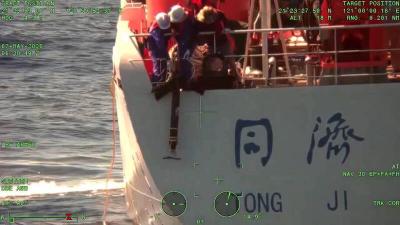
The coast guard today said that it had disrupted "illegal" operations by a Chinese research ship in waters close to the nation and driven it away, part of what Taipei sees a provocative pattern of China's stepped up maritime activities. The coast guard said that it on Thursday last week detected the Chinese ship Tongji (同濟號), which was commissioned only last year, 29 nautical miles (54km) southeast of the southern tip of Taiwan, although just outside restricted waters. The ship was observed lowering ropes into the water, suspected to be the deployment of scientific instruments for "illegal" survey operations, and the coast

A former soldier and an active-duty army officer were yesterday indicted for allegedly selling classified military training materials to a Chinese intelligence operative for a total of NT$79,440. The Taipei District Prosecutors’ Office indicted Chen Tai-yin (陳泰尹) and Lee Chun-ta (李俊達) for contravening the National Security Act (國家安全法) and the Anti-Corruption Act (貪污治罪條例). Chen left the military in September 2013 after serving alongside then-staff sergeant Lee, now an army lieutenant, at the 21st Artillery Command of the army’s Sixth Corps from 2011 to 2013, according to the indictment. Chen met a Chinese intelligence operative identified as “Wang” (王) through a friend in November


 RSS
RSS